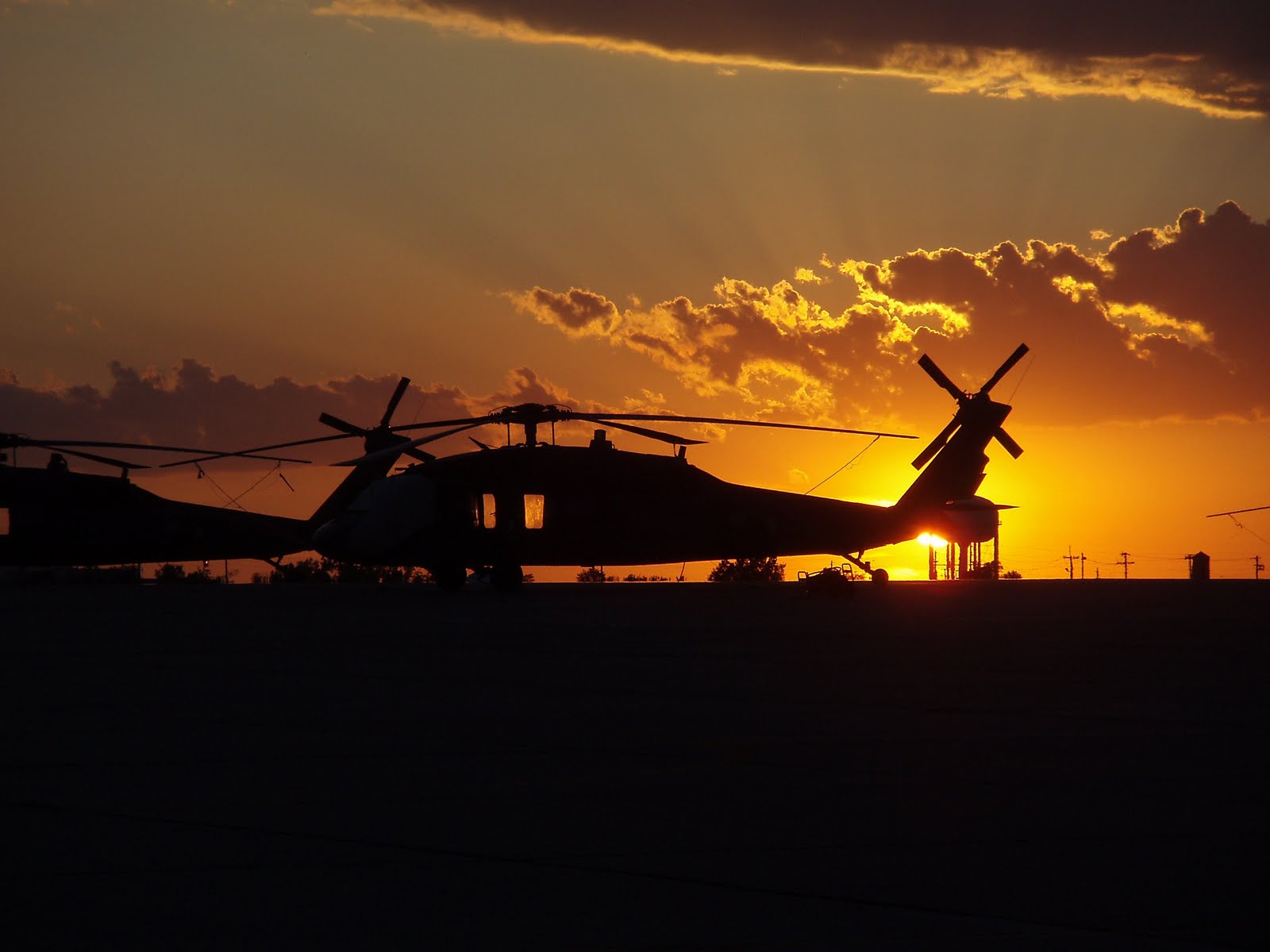
Somewhere on a dust swept flightline across the globe, a military MEDEVAC helicopter crew is having a day like this... (reprinted from May 2009)
The door to the first up ready room swung open and our platoon leader stuck his head inside.
Surfing the internet and watching DVDs on our laptops, seven and a half hours into our duty day, we barely noticed.
“You guys might have a nine-line coming in, not sure if its urgent or priority”.
Mentally snapping out of our “crew rest profile” that we maintain for a 24 hours at a time on 1st up, we were thankful for the warning. Most of the eight crew members for our two first up UH-60s hustled to the operations office, fifty yards away. There had been false alarms before. Sometimes missions are canceled before we can get the engines started. Sometimes missions that we think belong to us actually are closer to another MEDEVAC company. Sometimes the location changes. Sometimes what appears to be an urgent mission ends up being a routine transfer request and we get all wound up for nothing. Sometimes the missions are bogus.
But sometimes minutes count, and American GIs, or Iraqi Army troops, or Iraqi civilians, or even enemy insurgents are in pain, bleeding, and dying as the clock ticks.
That is what we are here for.
And when the call for MEDEVAC goes out, we go NOW. The battle captains and operations officers and staff toads can all take their time sorting out what we should have done, if we could have gone quicker, and why didn’t we notify them sooner. We will be back long before the finger pointing has begun in earnest.
But in the meantime we need to move hurt people. And we don’t in any circumstance want hurt people waiting on us. No GIs are going to die on our watch if we can do anything about it. It’s not heroism, its not self-aggrandizing propaganda, its just what we do.
What we do now is stare across the desk at the operations specialist on the phone. He’s getting something off the computer. There is probably some paperwork he already started on the counter. Wait, did he write down the location already? Do we know how many patients yet? He hasn’t pointed any fingers our way or called “MEDEVAC” across the radio yet. Are we wasting our time? Another phone rings. The operations specialist is still on the other phone. A senior medic answers it.
Tick. Tick. Tick.
The senior medic answers the second phone and confirms that it is an urgent mission. But operations still has not sent the call out for MEDEVAC. He probably doesn’t have all the information needed to launch us yet. Where did the pilot in command go? We should have everybody from our crew close by… Everybody should be in radio range… I key the radio…
“1st up lead PC, are you up?”
Tick. Tick. Tick. Too late. The operations specialist keys his radio.
“MEDEVAC, MEDEVAC, MEDEVAC”.
It is a familiar refrain, one that begins every urgent mission. The scary ones, the boring ones, the ones where we wake up at 2AM and are in the aircraft before our brains boot up, and the ones where the flight medics are fully engaged with critical patients in the back of the aircraft, telling us to speed up cause time matters. We joke around a lot, but we rarely joke using the word MEDEVAC because the mere mention of the word raises the blood pressure of any crewmember on duty. And anytime the radio breaks squelch in the middle of the night, we stop breathing.
But now the Standard Operating Procedure kicks in. The Pilot in Command and the medic will get as much information as they can in operations, to include weather and intelligence updates, while the crew chief and myself will get the aircraft ready to go. Whether the mission will be a big deal or a big waste of time and jet fuel is not our problem. We go now…
“Go!”
We hope nobody is on the other side of the door as we blow through it. Amazing track and field feats have been witnessed between operations and the aircraft during nine-lines. Bicycles and boxes hurdled, old and fat National Guard crewmembers setting 50 and 100 yard dash records, very entertaining.
This will be a quick launch, its mid afternoon, most if not all of us are awake and close by, and we can see. Night launches are the same, except for the seeing part. Ever tried to fasten a car seatbelt in the dark? Over body armor? Full of adrenaline? Not recommended.
After the short run to the aircraft, we begin dressing in our aviation combat gear, throwing our body armor vests over our heads first, taking care not to smash ourselves in the face with the ten pound armor plates. Over that goes the survival vests, with radios, ammunition, medical equipment, and whatever accessories we strapped to it months ago when we were in training. Gloves, earplugs, watches, kneeboards, and so forth are laid out in the aircraft where we left them. Or not. I notice for the first time that I am still holding the magazine I was reading in the ready room. Into the door pouch it goes. Into the seat I go.
As I strap into my seat, a lieutenant rides by on a bicycle, stopping to ask the crew chief a question about whether the aircraft is hoist capable. No doubt for some bean counting administrative tasking from headquarters. We don’t have the time to stare blankly or laugh.
“Clear!” I scream.
We are almost wearing earplugs and helmets by this time and are not up on intercom, and screaming does the trick for crew communications and sometimes wakes up people who are wandering about the flightline in a daze. Plus it sounds kinda cool.
“Clear” the crew chief screams back. Meaning there is nobody on the left side of the aircraft. By the APU exhaust. Which will soon be quite warm and loud beneath the nozzle.
I flip the switch that starts the Auxiliary Power Unit (APU) starting sequence. It’s the loud jet engine noise you hear on airliners sitting at the gate, and on larger helicopters that don’t have their blades turning. The APU runs the electrical systems that would otherwise be powered by the aircraft engines, and provides the compressed air source to start the engines themselves.
The APU is lit and howling as the medic runs up to the aircraft, medical bag and rifle in hand, and begins the same dressing sequence. We’ll have to scream more with the APU noise. I am flipping switches and turning on radios in sequence with the checklist. The pilot in command is still in operations, getting updates and figuring a course to the destination that will keep us clear of any friendly operations and airspace. We’d hate to fly through anybody’s firefight or air strike on the way to pick up hurt people, which happens occasionally. Mostly to those who don’t get updates.
“Where we going?” I scream, now to the medic.
“Warhorse!” he answers. Great. Forward Operating Base Warhorse, near Baqubah, former hangout of former Al-Qaeda in Iraq leader Abu Musab Al-Zarqawi, prior to the USAF delivering him a pair of 500 lb bombs one evening in 2006. If you want to get blown up or shot at, Warhorse and the residents of Baqubah will hook you right up.
I punch up the navigation system preset for Warhorse so that the destination will be loaded when we take off. The pilot in command arrives, with sticky note updates, and begins dressing. 75 meters away, an identical crew dance is happening in our chase aircraft, as we are a flight of two. The more, the merrier.
Tick. Tick. Tick.
I am up to the point where I can start the aircraft engines, but standard operating procedure is to wait for confirmation from the pilot in command. I gesture a request to start and he nods. Clear one. The crew chief verifies we are clear.
The GE turboshaft engine, with its near 2,000 horsepower comes to life with its characteristic low moan. The blades begin to turn. The second the #1 engine starter switches off, I am asking the crew chief to clear the #2 engine. In a minute both engines are started and the aircraft systems are beginning to stabilize. I can see that our chase aircraft’s blades are turning and they will not be far behind us in the start sequence. The remaining aircraft systems boot up, the aircraft is configured for flight, and final takeoff checks are completed. When our chase aircraft is ready to go, they transmit the code word over the radio. We acknowledge and are already calling tower as we pull power and are light on the wheels. The pilot in command (PC) makes the radio call.
“Tower, Alamo 10, flight of two UH-60s, request immediate departure alpha bravo, urgent MEDEVAC”.
“Alamo 10, cleared for immediate departure, report bravo” is the tower’s reply.
In the combat environment, locations and directions of departure and arrival are encoded so as to be indecipherable to anyone monitoring the radio who does not have a current airfield diagram. No sense in making it easy on the bad guys to figure out where we are going.
Picking up to a high hover, I nose the aircraft over and accelerate over the compound, over housing units, countless military vehicles and warehouses, and between Saddam-era aircraft shelters now filled with US air force planes and support equipment. Our chase aircraft falls in behind us and we cross the fence into greater Iraq, approaching maximum level speed.
Eight minutes from notification, Alamo flight is airborne and enroute. Not bad.
We avoid over flight of buildings and flocks as best we can. At this altitude and speed, we can just barely make out the Iraqi people in their red and black robes as they go about their business in the fields and small villages surrounding the base. From the air, it seems peaceful below. We wonder what the Iraqis think of us as we blow over their houses, day and night, on our way to lifesaving missions. Probably nothing good. One of our pilots has remarked that they probably don’t know that they are shooting at Iraqi patients half the time when they start shooting at our aircraft. Today, we don’t notice if anyone shoots at us. Our plan is to be half a mile away by the time they can aim their weapons at us.
“Did you see THAT?” says the PIC.
Few of us did, but a few miles away, very near where we plan to be flying, a thick column of black smoke rises from a burning vehicle along a small road. The PIC just saw the vehicle explode. We consider reporting what we have seen to headquarters, until we look closer and see two AH-64 Apache helicopters already circling the scene.
For now we choose to avoid the site by several miles. We would find out many hours later that this burning vehicle is where our casualties had come from, and the unit had back hauled the casualties to Warhorse instead of calling us directly to the scene.
Soon the fire is behind us, and we are looking ahead on the map and out the window for a clear approach to the base. A fairly large city is in our path, but working our way in from the north we can avoid most of the built up areas and not shake too many roofs. A few minutes out, the PIC is already talking to the base tower on one radio, and the medic has contacted the medics on the ground. We are less than a mile out now, on a close in downwind approach which keeps us clear of the base and clear of the built up areas off base, oh yeah, and a big antenna right in the middle. I radio the chase aircraft to give us lots of space for the base turn.
Abeam the landing point just below cruise speed, I bank hard, bleeding off airspeed rapidly and keeping the turn in tight. Properly executed, this will give us minimum exposure time to bad guys near the base, while we line up on final approach at a speed that won’t have us pulling gobs of power in at the bottom to stop. Coming in fast is great if you can get stopped in time…
We do all right, and both aircraft are soon lined up on a decelerating final approach. This pad is hard enough to see in daylight, and near impossible at night when the pad is lost in the dark spots between blinding lights elsewhere on the base. In seconds we are calling “landing” to the tower and touching down on the helipads surrounded by protective barriers, where a HMMWV ambulance waits just outside the walls. As soon as the parking brake is set and the flight controls are centered, the flight medics and crew chiefs of both aircraft are scrambling out their windows to get to the ambulance.
There is still some confusion as to how many patients we have. Possibly as many as four. While our medics sort it out at the ambulance with the ground medics, the crew chiefs provide crowd control under the rotor disk, and over the radio, both aircrews discuss contingencies for different numbers of patients. In the case of one critical patient, sometimes both medics will go on one aircraft with the patient, but today it looks like we’ll have plenty of patients to keep both medics busy in their respective aircraft.
The final vote is two, one for each aircraft. The infantrymen have taken shrapnel and have some burns, but look to be OK. Stripped down to an army blanket and oxygen mask, our patient gives us a thumbs-up as he is loaded into the litter pan in back. A good sign.
A quick before takeoff check and we are airborne again and soon over the fence and speeding back to the hospital with the two wounded. The burning vehicle that we saw earlier appears to have gone out. We avoid the area anyway. Everyone is happy that these two wounded are stable and will make it to the hospital for the handoff to level three care.
Halfway back, the medics transmit patient information to the emergency room, and within minutes we are touching down at the hospital pad, two aircraft in trail. Seconds later, the medics and crew chiefs jump out of the aircraft and are met by several members of the hospital staff and litter team, who wheel the patients through the flag draped entrance to the hospital. Inside the medics will confer with the receiving medical personnel and hand off with impressive speed. Two more satisfied customers.
Our medics return with new litters, and we make the short flight to our unit, where oxygen tanks and medical supplies are restocked, and the aircraft given a final walk around in case we need to launch again soon. Engines are shut down, the blades stop, and now the paperwork and after action review process begins for the next half hour or so.
We’re not quite sure what the night will hold next, but we are ready. So we go to dinner. It’s chicken again.
ALAMO DUSTOFF.