The French Air Force has released video of two air strikes on enemy positions in Mali. The second appears to be a helicopter strike. Don't know what type of ordnance was used in the first strike but it was BIG. H/T David Cenciotti at The Aviationist.
Popular Posts
-
 Since the successful raid on Bin Laden’s compound in Abbottabad, Pakistan in early May of this year, much has been made of the ...
-
 During a test flight on 7 Aug 2012, a Bell 214 test aircraft reportedly lost tail rotor control ... and possibly tail rotor co...
-
 Update 05/2016: Please check out my most recent review for the Lightspeed Tango Wireless Headset helicopter version. Hard to f...
Showing posts with label helicopter. Show all posts
Showing posts with label helicopter. Show all posts
Sunday, January 27, 2013


Tuesday, December 25, 2012
Telex Stratus Heli-XT ANR headset review

Update 05/2016: Please check out my most recent review for the Lightspeed Tango Wireless Headset helicopter version.
Hard to find reviews on this item, so I am writing my own. Skygeek's price is the best I have found on this item.
For what its worth, I own two DC headsets, a converted H10-40 and a passive H10-56, and a Bose X. I primarily fly S76s and 407s in the gulf.
The Heli-XT is slightly bigger than most headsets. Normally not a problem but when you turn your head you can bang it on head cushions, etc. at times. Many headsets leave you with extra cord dangling around the cockpit but this coiled cord is just the right length with not a lot of slack. The earcups are not left and right specific so you can just throw the mike boom over the top and hook in on whichever side is closest to the ICS plug.
The AA batteries are consumed at a pretty fast rate. Use rechargeables. My headset came with two 2450 mAh AA rechargable batts AND a charger that hooks directly into the battery compartment, so unless you want a wall charger you will already be set up.
Passive protection is excellent due to the big ear cushions. The ANR is not as aggressive as some higher end sets but it does improve the audio quality. If the batteries and ANR temporarily run out, its not a big deal because of the high degree of passive protection.
Headband clamping force is pretty firm (and adjustable), but not uncomfortable. I have a pretty big noggin and wearing it for six hours straight does not cause any problems.
Volume level can be adjusted very high, which I love since I fly with earplugs also, and other headsets I have flown can be difficult to hear with earplugs in.
Audio quality clear in and out. We'll see how it holds up over the long term but so far I am very happy with this purchase.
*** Update 4/2016
Over the past three plus years, the Heli-XT headset has held up quite well, flying 300-400 hours per year in commercial use. It has never been in for repair but I replaced the ear cushions once when the foam finally wore through! This is not a top-of-the-line headset but is a very capable and functional headset that should meet the needs of most pilots, and at a very good price.
I have never used the charger that plugs directly into the headset to charge the batteries, it was easier for me to purchase an Energizer or Eveready wall charger (with included batteries) and keep one set of batteries in the headset and the other set as a backup. You will not have a hard time figuring out when the headset batteries are low, if you miss the flashing red light, you will hear a lot of strange noises and then static in the headset as the batteries give up the last of their charge.
Over the last few months, I have experienced some problems with the power button while turning the ANR on and off, and wear on the battery door which causes the battery door to fall off by itself sometimes, but the ANR still works well. I emailed Telex customer service for instructions on returning the headset for a factory refurb but they never did email me back. I plan on keeping this headset as a spare, and buying a Lightspeed Tango for my new primary headset, review to follow!
Friday, September 7, 2012
Thought for the day...

Today's topic is SITUATIONAL AWARENESS!
If today you were preflighting your helicopter in the dark, and an orangutan was sitting silently on top of the mast...
HOW LONG WOULD IT BE BEFORE YOU NOTICED???
Don't forget to do a walk-around. They don't cost much.
Peace, Errwolf
Saturday, July 14, 2012
The Crank of the X3
Eurocopter's X3 Helicopter will no doubt be very sleek and fast, but I'd say it will be a little dangerous on the ground for those who are used to loading and unloading with the rotors turning!
Why Helicopter Design is Difficult
This short video of visualized airflow around a CH-47 in flight demonstrates the challenges facing rotary wing design engineers. The speaker, Dick Spivey, is considered to be the father of the V-22 program. (H/T Rotor and Wing editor Andrew Parker for this).
Sunday, June 17, 2012
Stealth Helicopters Revisited

Chuck Pfarrer's excellent book Seal Target Geronimo has been available for some time now and is a great read. The book covers a variety of topics from the background of terrorism in the Middle East to the inside details of Operation Neptune Spear, aka the Osama Bin Laden raid.
Chuck Pfarrer is a former DEVGRU member and claims to have inside information on Neptune Spear based on his association with those involved in the mission. There has been no small amount of controversy involving Mr. Pfarrer's version of the facts... the same which can be said of the "official" version of the raid provided by the Obama administration and various leakers throughout the government. Since my previous post on Stealth Helicopters garnered so much interest, I thought I'd comment on some of the aviation related content in the book with my best educated guess on "what really happened".
I would first like to state that I am not a Seal, nor a SOCOM guy of any stripe, just an old Army Aviator with some plain vanilla UH-60 time. This is why I restrict my comments to the aviation related items. Enough disclaimers, post continues...
Claim: (page 15) In June 2006, a SEAL sniper team laser designates a building near the northwest corner of Baghdad where Abu Musab al-Zarqawi is hiding, guiding in a CIA controlled Predator Drone which fires a Hellfire missile, killing Zarqawi.
All previous versions of this story have USAF F-16s dropping laser guided bombs on the house containing Zarqawi. This does not mean that the SEALs were not there designating the target, the only thing is dispute is the weapon that was dropped. Also, the location of Zarqawi's safe house was reported to be in Baqubah... a long way from the northwest corner of Baghdad.
Whatever the truth is, few would disagree that the CIA controls Predators with Hellfire missiles, that the USAF drops laser guided bombs from F-16s, that SEAL sniper teams can certainly lay up in a hide site and designate targets, and that the death of Zarqawi saddens no one outside of his following in Iraq.
Claim: (page 153) the helicopters used in the Bin Laden raid were "Stealth Hawks", one of a silent and stealthy generation of modified UH-60s.
The tail section of the wrecked helicopter that was left at the objective appeared to be that of a modified UH-60. Task Force 160, which flies quite a few SOCOM missions, possesses the most highly modified and expensive UH-60s out there, and it is not much of a stretch to imagine that the newest aircraft they have are equipped with cutting edge classified technology.
Interestingly though, all sources seem to indicate that MH-47s were used to extract the task force. Whether they were backup aircraft or part of the original plan is anybody's guess, but apparently it didn't take a quiet and stealthy helicopter to get in and out of the objective, at least once the element of surprise was achieved. If the raid indeed lasted near 40 minutes, that would seem to indicate that extraction was delayed... I would hope that the raid was planned for a MUCH shorter time frame on the objective.
Claim: (page 173) With ADM McRaven watching, a "supersonic" RQ-170 UAV makes an afterburning takeoff into a vertical climb at a base in Afghanistan.
Real dramatic, but I'm thinking not. The RQ-170 I'm thinking of is powered by a GE TF34 engine that produces less than 10,000 pounds of thrust, and which also powers the S-3 Viking and the A-10 Thunderbolt, as well as a stable of civilian regional jets. All aircraft not known for their vertical climb capabilities, nor their afterburners, nor their supersonic performance. Being that they now own one, I guess we could ask the Iranians if they have any further info they could share with us?
Claim: (page 181) The assault plan called for the first helicopter, Razor 1, to drop assaulters on the roof of the main building.
This is where Pfarrer's version of events make far more sense than the "official" version of the events, wherein the helicopters dropped everyone on the ground and the assault teams cleared the building from the ground up. Assuming you can quickly drop or rope your people vertically onto the buildings, it would be a tactically bad idea to jump out of a helicopter and then fight your way from the bottom of the building up. Why do things the hard way if you don't have to? Why show up in a helicopter and then get out and run up the stairs?
Claim: (page 189) The tail rotors of the helicopters used in the raid are shrouded.
Nope. Not in the pictures of the wreckage.
Claim: (page 199) Razor 1 landed on the roof of the building and remained there during the raid, rotors turning.
Maybe... but as any infantryman will tell you, vehicles draw fire, and I'd rather be circling the target than presenting a great big stationary target smack on top of the objective. Apart from the obvious risk of setting down a many-ton helicopter on the roof of a building built in Pakistan...
Claim: (page 200) Razor 1 took off from the main building, rotating clockwise, and crashing into the compound due to the failure of a "green unit", a system that "controlled flight inputs and communications, and managed navigational problems".
This has got to be my favorite...
First off, there is no such component in the UH-60, at least in the basic version. If there is, I hope it was under warranty. It sounds like a real piece of junk. Although the UH-60 has historically experienced failures of supposedly redundant components (dual-engine rollback) the chances of a simultaneous catastrophic failure of two systems is, as Pfarrer puts it, "a million to one shot". The chances of there being a single pair of components on the aircraft that handle flight control, commo, and navigation is even less I would add.
So what took down Razor 1? If indeed the helicopter did spin clockwise and crash, that is indicative of either a loss of tail rotor effectiveness or a tail rotor malfunction of some kind. I would guess that the cause was much simpler, Razor 1 hit a wall with the tailboom or tail rotor during the initial insertion.
Much has been made of the reduced hover performance of the stealth modifications, "vortex ring state" and strange aerodynamic phenomenon known only to congressmen who describe air of different densities and temperatures being on two different sides of the compound walls which somehow steals lift from helicopters. But there are many tried and true ways to crash a helicopter and we don't need to make up any new ones.
Air assaults are hard. An air assault of this magnitude on this target is much harder. Many lives are on the line. Seconds count. Timing is vitally important. The aircraft hit the landing zone quickly and simultaneously, and everyone typically browns out. Bad things happen, no matter how many rehearsals take place. To see what this looks like in real time, look at this video of another special forces raid in Iraq. During a daylight operation, the third aircraft... smacks its tailboom into the wall.
But you know what? The operators drive on and the mission is accomplished anyway. Just like in Abbottabad.
H/T to David Cenciotti at The Aviationist for the best Stealth Blackhawk info on the net!
And a big salute to the men who pulled this off despite the odds.
Friday, December 30, 2011
Safety Program or a Safe Program?
 |
| The point at which your safety program becomes irrelevant |
There is a huge difference between having a safety program and operating safely. The difference can mean life or death. A few examples:
1. September 18th, 2008. An Army National Guard helicopter crosses from Kuwait into southern Iraq for the first time since arriving in country for a nine month tour. The organization at all levels has school trained safety officers, trained at the Army Safety Center at Fort Rucker, which believes (and practices) that enough micromanagement can achieve a zero accident rate in the Army. There are safety conferences, safety meetings, safety councils, safety surveys, safety briefings, risk assessments, and safety is preached and drilled constantly during a months-long train up for the deployment.
But that evening, it doesn't matter, as inexperienced pilots take off in marginal weather into the dark featureless desert. Within minutes after crossing into country, the third aircraft in the formation, Red River 44, crashes into the desert floor at 130 knots, killing the crew and passengers.
2. April 20th, 2010. BP has a great safety program, if not a great safety record. Contract employees are subject to intensive interviews before being allowed to work for BP. Many of these third party providers fail to live up to BP's safety standards. New arrivals at BP facilities are shaken down for contraband. Passengers must be escorted by approved escort personnel to aircraft that are shut down, no hot refueling, no hot passenger loading. Safety is practiced well past the point of operational intrusion. There are safety audits and safety consultants and safety inspections and safety meetings and long safety conventions, and awards and accolades given to the safest of the safe operators.
But that evening, it doesn't matter, as the Deepwater Horizon crew, recipients of a recent safety award, bypass all manner of established protocols downhole and cause a blowout that kills 11, and an epic oil spill that the domestic offshore drilling industry will take years to recover from.
3. Ongoing. A major provider of worldwide offshore helicopter services hosts an expanding safety department that issues frequent safety alerts on such imperative workplace dangers as:
a. People walking into trailer hitches in the parking lot at company headquarters.
b. People walking into filing cabinets at company headquarters.
c. People injuring themselves standing up from chairs at company headquarters.
4. Have you taken a state approved Defensive Driving Course lately? Enough said.
It is a given that people will often brush safety concerns aside in favor of getting the job done, absent any controls. It is also a given that safety programs are often born out of industrial accidents, that the rules are written in blood, and that THE PROGRAM IS PUT IN PLACE LARGELY TO COVER MANAGEMENT'S REAR END AFTER AN ACCIDENT. Later, the overly restrictive new programs are at least partially ignored on the line, and the process repeats itself, sometimes at the cost of many lives.
So what exactly can be done? How can a safety program be engineered so that it actually makes a difference and a meaningful connection between the program and the employees? A few ideas from the field:
1. The safety department must be trusted and respected both up and down. Safety must report directly to top management so as to minimize political interference, and personnel on the line must be able to bring their concerns to the safety department where they will be given a fair hearing, without fear of retribution. The moment that the line perceives that the safety department is blowing off their concerns, or worse, is a hit man for management, the safety department will have forever lost the cooperation of the line. Moreover, if the line is engaged in operating, maintaining, and fueling aircraft in harsh conditions worldwide and your safety department is primarily focused on office hazards... your safety program has become a JOKE.
2. The safety department needs to be out in the field. Often the best thing that safety personnel can do is push back from the desk and get out in the field to beat the bushes for potential problems. Not with a checklist and a charter to document the sins of the field, but to talk to people and to understand that they alone do not understand the whole picture. They might be surprised to find out that they can learn more in one afternoon of walking around than they would on several out of state safety conferences where they hobnob with equally clueless safety program managers from across the industry.
3. Standards must be enforced. Much as I hate to admit it, the proliferation of exceedance monitoring and tracking equipment in the industry has had a dramatic effect on standardization. What that means is that if you have a little box in the aircraft that is tracking everything you are doing, and management can see what you are doing any any given time... guess what? People will behave better. They won't like the intrusiveness, but they will behave better, because they really won't have a choice. What management ultimately does with this data is a whole nuther topic, and one that will set the tone for the acceptance of the program, grudging or otherwise.
Ideally, if the line and safety work well together, the majority of threats will be identified and managed. There will always be unsafe people, unsafe acts, and stupid policies, and they will all have to be dealt with. But no one at any level should ever confuse a safety PROGRAM with a SAFE program.
Monday, August 8, 2011
Stealth HELICOPTERS???

Since the successful raid on Bin Laden’s compound in Abbottabad, Pakistan in early May of this year, much has been made of the mysterious “stealth helicopter” which reportedly crashed during the initial phase of the raid. Due to the loss of one helicopter and a section of its modified tail boom falling outside the walled compound, there was plenty of news fodder that brought out numerous self-appointed aviation experts, and speculation that ranged from wild guesses to opinions that defied both physics and the physical evidence at the crash site. With only the tail boom of the new design to look at, it appears that the regular four bladed tail rotor was replaced with a five bladed design, and a hubcap-like cover was mounted over normally exposed tail rotor linkages, which would make at least the tail rotor both quieter and stealthier.
But like “jumbo shrimp” and “military intelligence”, “stealth helicopter” is a awkward concept at best. While it is possible to make a helicopter quieter and while its huge radar-reflecting cross section might be made smaller, helicopters in this class are still a twenty thousand pound whirling mass of rotating and vibrating parts. All of this does not add up to a package that “can be hovering right next to you, and you wouldn’t know it”. With all apologies to Blue Thunder, Airwolf and even the Romulans, it just cannot be done. Ditto for the claim that the helicopter “can be coming towards you, but it sounds like its moving away” and “can’t be heard until its right on top of you”. No, no, and NO!
So what can be done to make a helicopter more stealthy? Several things.

Quieter rotor blades, such as this “Blue Edge” blade developed by Eurocopter significantly cut down on rotor noise (listen to the noise comparison in the above link). Low noise designs such as this are not new technology, they have been operationally employed since Vietnam.
Both the hot exhaust and noise of engines can be suppressed somewhat through creative ducting around the intakes and exhausts.
Sikorsky builds both the UH-60 Blackhawk series of helicopters and the now canceled RAH-66 Comanche scout helicopter, designed from the ground up to be a more stealthy design. It is not in the economic or business interests of either the DoD or the contractor to reinvent the wheel, so you can bet that the easiest, cheapest, and quickest way to modify a UH-60 was with bolt-on panels that were remarkably similar to what was developed for the Comanche program. In fact, in 1991 at the Paris Air Show, the Sikorsky “Fantail” design built for the Comanche was first demonstrated to the public on a S-76B, another Sikorsky helicopter, which was itself a derivative of the UH-60. Therefore, the safest guess is that the helicopter that crashed during the raid was a modified UH-60 which would look more like a Comanche.
 |
| UNMODIFIED UH-60 BLACKHAWK |
 |
| RAH-66 COMANCHE |
 |
| "STEALTH" UH-60 BLACKHAWK (ARTIST CONCEPTION) |
Would these modifications make the helicopter more difficult to control, and cause the crash, as some have proposed? Maybe.
There is very little correlation between fixed wing aerodynamics and rotary wing aerodynamics in a hover, so comparisons between the flight characteristics of a high flying stealth airplane and a modified helicopter are mostly meaningless.
Adding weight and changing the shape of the airframe can definitely affect flight characteristics and controllability, but its not as if this mission was not rehearsed and flown in simulators many times. High altitude may also have been a factor, but Denver is higher than Abbottabad, and helicopters routinely operate in Afghanistan at much higher altitudes. At the end of the day, when you are sneaking in low, in close formation, in the middle of the night, on what is possibly the biggest clandestine raid of the war, there are about five hundred ways to crash a helicopter that have nothing to do with airframe design and high altitude.
As for the leaked explanation that the helicopter crashed because the temperature was different inside the compound, so the helicopter “couldn’t hold the hover”... I cannot locate anybody who has been flying helicopters for any length of time who has any idea what the congressman is talking about. Perhaps it’s a aerodynamic phenomenon unique to Pakistan?
Stealth helicopter or not, was stealth really a must-have requirement for this mission? Probably not.
First up, Pakistan is not noted for their impenetrable air defense network. We give their equipment and their operators far too much credit, and our own people far too little. If Mathias Rust could land a Cessna in Red Square, having flown in from Finland, how do you like the odds of the Pakistanis vs. Task Force 160? Backed up by the US Air Force and Navy?
Secondly, the US did not just Hail Mary two helicopters into Pakistan and hope things went well. This was likely one of the most overplanned operations in modern warfare, with all manner of diversions, electronic jamming, and reinforcements on call for every contingency imaginable. The fact that they were able to lose a helicopter and still execute the mission and extract in around forty minutes is testimony to the professionalism and the preparedness of the team on the mission.
Thirdly, THE PAKISTANIS KNEW BIN LADEN WAS THERE and any Pakistani forces able to respond to an attack on the compound were either smart enough to stay away, slow enough to not make a difference, or dumb enough to not even notice.
And lastly, the number one reason why this mission did not need a stealth helicopter… the task force extracted on Chinooks! About as stealthy as a Greyhound bus… though not as quiet.
Sunday, June 19, 2011
Wisdom o' the Gulf

(Originally published in Autorotate Magazine)
ERRWOLF’S GENERALIZED GULF WISDOM
(or, “Mistakes I’ve Made Lately”)
A sleeping passenger is a happy passenger.
A quick walk around inspection is the cheapest insurance you can get.
Get rushed, get complacent, get hurt.
How would you explain what you are doing right now to an accident investigator?
Pay attention to the old farts. Well, most of them.
Jet A etiquette: When on the beach, take as much fuel as you can carry. When offshore, take no more fuel than you need.
A swimming passenger is a most unhappy passenger.
Work boats are in a unique position to notice changes in the weather sooner than anyone else. Many of them have radar. If they start calling YOU to tell you about the weather, I hope you’re tied down.
Turning the blade by hand before starting is a good way to check for those annoying tiedowns you may have forgotten.
Want to meet a crane operator? Land and take off when he’s operating the crane and doesn’t know you’re there.
A passenger who had to take the boat because of bad weather may be a crabby passenger, but he’ll live through the ride.
Some great truths in the Gulf of Mexico:
1. You will have a headwind when you are short on gas.
2. You will have bad visibility if you’re not sure where the destination is.
3. You will have more flight time than sleep time the day after you stay up too late. (Try it, it works)
Above all else, fly the aircraft.
Wash your own dishes and sheets and you’ll live longer.
A passenger who is upside down in a helicopter full of water is the unhappiest passenger of all. This is why you should brief your passengers, preferably before you leave and not halfway through an emergency procedure.
If you need help at the shore base to put 30 gallons in your Bell 206 at 7AM on a Thursday, you are part of the problem.
There are two times when you especially need to do a walk around inspection of the aircraft:
1. When you are unfamiliar with your aircraft, and:
2. When you are all too familiar with your aircraft.
The more you check the weather, the less you will be surprised when some weather shows up.
Don’t feel so paranoid, they’re all trying to kill me too.
Fly safe, EW
Army MEDEVAC story

Somewhere on a dust swept flightline across the globe, a military MEDEVAC helicopter crew is having a day like this... (reprinted from May 2009)
The door to the first up ready room swung open and our platoon leader stuck his head inside.
Surfing the internet and watching DVDs on our laptops, seven and a half hours into our duty day, we barely noticed.
“You guys might have a nine-line coming in, not sure if its urgent or priority”.
Mentally snapping out of our “crew rest profile” that we maintain for a 24 hours at a time on 1st up, we were thankful for the warning. Most of the eight crew members for our two first up UH-60s hustled to the operations office, fifty yards away. There had been false alarms before. Sometimes missions are canceled before we can get the engines started. Sometimes missions that we think belong to us actually are closer to another MEDEVAC company. Sometimes the location changes. Sometimes what appears to be an urgent mission ends up being a routine transfer request and we get all wound up for nothing. Sometimes the missions are bogus.
But sometimes minutes count, and American GIs, or Iraqi Army troops, or Iraqi civilians, or even enemy insurgents are in pain, bleeding, and dying as the clock ticks.
That is what we are here for.
And when the call for MEDEVAC goes out, we go NOW. The battle captains and operations officers and staff toads can all take their time sorting out what we should have done, if we could have gone quicker, and why didn’t we notify them sooner. We will be back long before the finger pointing has begun in earnest.
But in the meantime we need to move hurt people. And we don’t in any circumstance want hurt people waiting on us. No GIs are going to die on our watch if we can do anything about it. It’s not heroism, its not self-aggrandizing propaganda, its just what we do.
What we do now is stare across the desk at the operations specialist on the phone. He’s getting something off the computer. There is probably some paperwork he already started on the counter. Wait, did he write down the location already? Do we know how many patients yet? He hasn’t pointed any fingers our way or called “MEDEVAC” across the radio yet. Are we wasting our time? Another phone rings. The operations specialist is still on the other phone. A senior medic answers it.
Tick. Tick. Tick.
The senior medic answers the second phone and confirms that it is an urgent mission. But operations still has not sent the call out for MEDEVAC. He probably doesn’t have all the information needed to launch us yet. Where did the pilot in command go? We should have everybody from our crew close by… Everybody should be in radio range… I key the radio…
“1st up lead PC, are you up?”
Tick. Tick. Tick. Too late. The operations specialist keys his radio.
“MEDEVAC, MEDEVAC, MEDEVAC”.
It is a familiar refrain, one that begins every urgent mission. The scary ones, the boring ones, the ones where we wake up at 2AM and are in the aircraft before our brains boot up, and the ones where the flight medics are fully engaged with critical patients in the back of the aircraft, telling us to speed up cause time matters. We joke around a lot, but we rarely joke using the word MEDEVAC because the mere mention of the word raises the blood pressure of any crewmember on duty. And anytime the radio breaks squelch in the middle of the night, we stop breathing.
But now the Standard Operating Procedure kicks in. The Pilot in Command and the medic will get as much information as they can in operations, to include weather and intelligence updates, while the crew chief and myself will get the aircraft ready to go. Whether the mission will be a big deal or a big waste of time and jet fuel is not our problem. We go now…
“Go!”
We hope nobody is on the other side of the door as we blow through it. Amazing track and field feats have been witnessed between operations and the aircraft during nine-lines. Bicycles and boxes hurdled, old and fat National Guard crewmembers setting 50 and 100 yard dash records, very entertaining.
This will be a quick launch, its mid afternoon, most if not all of us are awake and close by, and we can see. Night launches are the same, except for the seeing part. Ever tried to fasten a car seatbelt in the dark? Over body armor? Full of adrenaline? Not recommended.
After the short run to the aircraft, we begin dressing in our aviation combat gear, throwing our body armor vests over our heads first, taking care not to smash ourselves in the face with the ten pound armor plates. Over that goes the survival vests, with radios, ammunition, medical equipment, and whatever accessories we strapped to it months ago when we were in training. Gloves, earplugs, watches, kneeboards, and so forth are laid out in the aircraft where we left them. Or not. I notice for the first time that I am still holding the magazine I was reading in the ready room. Into the door pouch it goes. Into the seat I go.
As I strap into my seat, a lieutenant rides by on a bicycle, stopping to ask the crew chief a question about whether the aircraft is hoist capable. No doubt for some bean counting administrative tasking from headquarters. We don’t have the time to stare blankly or laugh.
“Clear!” I scream.
We are almost wearing earplugs and helmets by this time and are not up on intercom, and screaming does the trick for crew communications and sometimes wakes up people who are wandering about the flightline in a daze. Plus it sounds kinda cool.
“Clear” the crew chief screams back. Meaning there is nobody on the left side of the aircraft. By the APU exhaust. Which will soon be quite warm and loud beneath the nozzle.
I flip the switch that starts the Auxiliary Power Unit (APU) starting sequence. It’s the loud jet engine noise you hear on airliners sitting at the gate, and on larger helicopters that don’t have their blades turning. The APU runs the electrical systems that would otherwise be powered by the aircraft engines, and provides the compressed air source to start the engines themselves.
The APU is lit and howling as the medic runs up to the aircraft, medical bag and rifle in hand, and begins the same dressing sequence. We’ll have to scream more with the APU noise. I am flipping switches and turning on radios in sequence with the checklist. The pilot in command is still in operations, getting updates and figuring a course to the destination that will keep us clear of any friendly operations and airspace. We’d hate to fly through anybody’s firefight or air strike on the way to pick up hurt people, which happens occasionally. Mostly to those who don’t get updates.
“Where we going?” I scream, now to the medic.
“Warhorse!” he answers. Great. Forward Operating Base Warhorse, near Baqubah, former hangout of former Al-Qaeda in Iraq leader Abu Musab Al-Zarqawi, prior to the USAF delivering him a pair of 500 lb bombs one evening in 2006. If you want to get blown up or shot at, Warhorse and the residents of Baqubah will hook you right up.
I punch up the navigation system preset for Warhorse so that the destination will be loaded when we take off. The pilot in command arrives, with sticky note updates, and begins dressing. 75 meters away, an identical crew dance is happening in our chase aircraft, as we are a flight of two. The more, the merrier.
Tick. Tick. Tick.
I am up to the point where I can start the aircraft engines, but standard operating procedure is to wait for confirmation from the pilot in command. I gesture a request to start and he nods. Clear one. The crew chief verifies we are clear.
The GE turboshaft engine, with its near 2,000 horsepower comes to life with its characteristic low moan. The blades begin to turn. The second the #1 engine starter switches off, I am asking the crew chief to clear the #2 engine. In a minute both engines are started and the aircraft systems are beginning to stabilize. I can see that our chase aircraft’s blades are turning and they will not be far behind us in the start sequence. The remaining aircraft systems boot up, the aircraft is configured for flight, and final takeoff checks are completed. When our chase aircraft is ready to go, they transmit the code word over the radio. We acknowledge and are already calling tower as we pull power and are light on the wheels. The pilot in command (PC) makes the radio call.
“Tower, Alamo 10, flight of two UH-60s, request immediate departure alpha bravo, urgent MEDEVAC”.
“Alamo 10, cleared for immediate departure, report bravo” is the tower’s reply.
In the combat environment, locations and directions of departure and arrival are encoded so as to be indecipherable to anyone monitoring the radio who does not have a current airfield diagram. No sense in making it easy on the bad guys to figure out where we are going.
Picking up to a high hover, I nose the aircraft over and accelerate over the compound, over housing units, countless military vehicles and warehouses, and between Saddam-era aircraft shelters now filled with US air force planes and support equipment. Our chase aircraft falls in behind us and we cross the fence into greater Iraq, approaching maximum level speed.
Eight minutes from notification, Alamo flight is airborne and enroute. Not bad.
We avoid over flight of buildings and flocks as best we can. At this altitude and speed, we can just barely make out the Iraqi people in their red and black robes as they go about their business in the fields and small villages surrounding the base. From the air, it seems peaceful below. We wonder what the Iraqis think of us as we blow over their houses, day and night, on our way to lifesaving missions. Probably nothing good. One of our pilots has remarked that they probably don’t know that they are shooting at Iraqi patients half the time when they start shooting at our aircraft. Today, we don’t notice if anyone shoots at us. Our plan is to be half a mile away by the time they can aim their weapons at us.
“Did you see THAT?” says the PIC.
Few of us did, but a few miles away, very near where we plan to be flying, a thick column of black smoke rises from a burning vehicle along a small road. The PIC just saw the vehicle explode. We consider reporting what we have seen to headquarters, until we look closer and see two AH-64 Apache helicopters already circling the scene.
For now we choose to avoid the site by several miles. We would find out many hours later that this burning vehicle is where our casualties had come from, and the unit had back hauled the casualties to Warhorse instead of calling us directly to the scene.
Soon the fire is behind us, and we are looking ahead on the map and out the window for a clear approach to the base. A fairly large city is in our path, but working our way in from the north we can avoid most of the built up areas and not shake too many roofs. A few minutes out, the PIC is already talking to the base tower on one radio, and the medic has contacted the medics on the ground. We are less than a mile out now, on a close in downwind approach which keeps us clear of the base and clear of the built up areas off base, oh yeah, and a big antenna right in the middle. I radio the chase aircraft to give us lots of space for the base turn.
Abeam the landing point just below cruise speed, I bank hard, bleeding off airspeed rapidly and keeping the turn in tight. Properly executed, this will give us minimum exposure time to bad guys near the base, while we line up on final approach at a speed that won’t have us pulling gobs of power in at the bottom to stop. Coming in fast is great if you can get stopped in time…
We do all right, and both aircraft are soon lined up on a decelerating final approach. This pad is hard enough to see in daylight, and near impossible at night when the pad is lost in the dark spots between blinding lights elsewhere on the base. In seconds we are calling “landing” to the tower and touching down on the helipads surrounded by protective barriers, where a HMMWV ambulance waits just outside the walls. As soon as the parking brake is set and the flight controls are centered, the flight medics and crew chiefs of both aircraft are scrambling out their windows to get to the ambulance.
There is still some confusion as to how many patients we have. Possibly as many as four. While our medics sort it out at the ambulance with the ground medics, the crew chiefs provide crowd control under the rotor disk, and over the radio, both aircrews discuss contingencies for different numbers of patients. In the case of one critical patient, sometimes both medics will go on one aircraft with the patient, but today it looks like we’ll have plenty of patients to keep both medics busy in their respective aircraft.
The final vote is two, one for each aircraft. The infantrymen have taken shrapnel and have some burns, but look to be OK. Stripped down to an army blanket and oxygen mask, our patient gives us a thumbs-up as he is loaded into the litter pan in back. A good sign.
A quick before takeoff check and we are airborne again and soon over the fence and speeding back to the hospital with the two wounded. The burning vehicle that we saw earlier appears to have gone out. We avoid the area anyway. Everyone is happy that these two wounded are stable and will make it to the hospital for the handoff to level three care.
Halfway back, the medics transmit patient information to the emergency room, and within minutes we are touching down at the hospital pad, two aircraft in trail. Seconds later, the medics and crew chiefs jump out of the aircraft and are met by several members of the hospital staff and litter team, who wheel the patients through the flag draped entrance to the hospital. Inside the medics will confer with the receiving medical personnel and hand off with impressive speed. Two more satisfied customers.
Our medics return with new litters, and we make the short flight to our unit, where oxygen tanks and medical supplies are restocked, and the aircraft given a final walk around in case we need to launch again soon. Engines are shut down, the blades stop, and now the paperwork and after action review process begins for the next half hour or so.
We’re not quite sure what the night will hold next, but we are ready. So we go to dinner. It’s chicken again.
ALAMO DUSTOFF.
Saturday, June 18, 2011
To the boats
My current contract involves crew and cargo transport to a fleet of boats which operate 150-250 miles offshore. I've attached a couple of videos of boat landings as seen from the helicopter.
There is a lot of camera bouncing in the first video where I attached the camera to the dash with some velcro. The helicopter doesn't bounce like that, but the camera sure did at the bottom of the approach.
The second video where the camera was mounted to my headset shows is less shaky, but the door post blocks some of the video!
In the shots where you can see inside the cockpit some of the screens look very strange, like the video is being drawn right before your eyes, that has something to do with the camera frame rate and the refresh rate on the screens. Through regular eyeballs it would just look like a normal screen display.
407 checkride
As part of my annual refresher training, we did a half an hour worth of touchdown autorotations in the Bell 407 helicopter. The point of the training is to be prepared for the possibility of an engine failure.
This particular maneuver is known as a "full down" (terminating in a power-off landing to the ground) 180 degree autorotation, beginning from about 500 feet on the downwind leg. The throttle is rolled to idle, which disconnects the rotor system from the engine, and after some flight control manipulations the rotor system transitions to a "driven state", where the only thing keeping the rotor turning is the air rushing through it, as the helicopter rapidly descends in a turn. At around 100 feet, the helicopter's nose is pulled up to slow the forward airspeed and descent rate, and in the last ten feet, the helicopter is leveled and the touchdown is "cushioned" by pulling pitch in the blades, using all the remaining energy in the rotor system to slow the blades and provide a soft touchdown. All of this happens pretty rapidly, in our case, about 25-30 seconds from when the throttle is rolled off until you are sliding along on the grass. Piece of cake.
In this video, the instructor was doing the first demonstration, mine were not quite as pretty.
Autorotation training can be dangerous, what happens if you attempt a 180 degree full down auto, and of the critical items (turn, flare, level, and cushion) you only score 50%? It looks a lot like this next video, and NO, the skids don't normally spread that far.
For this reason, our instructors are always ready on the controls in case we are a little slow, and in the Army, full down autorotation practice is something that is only done in flight school.
Thoughts upon military retirement
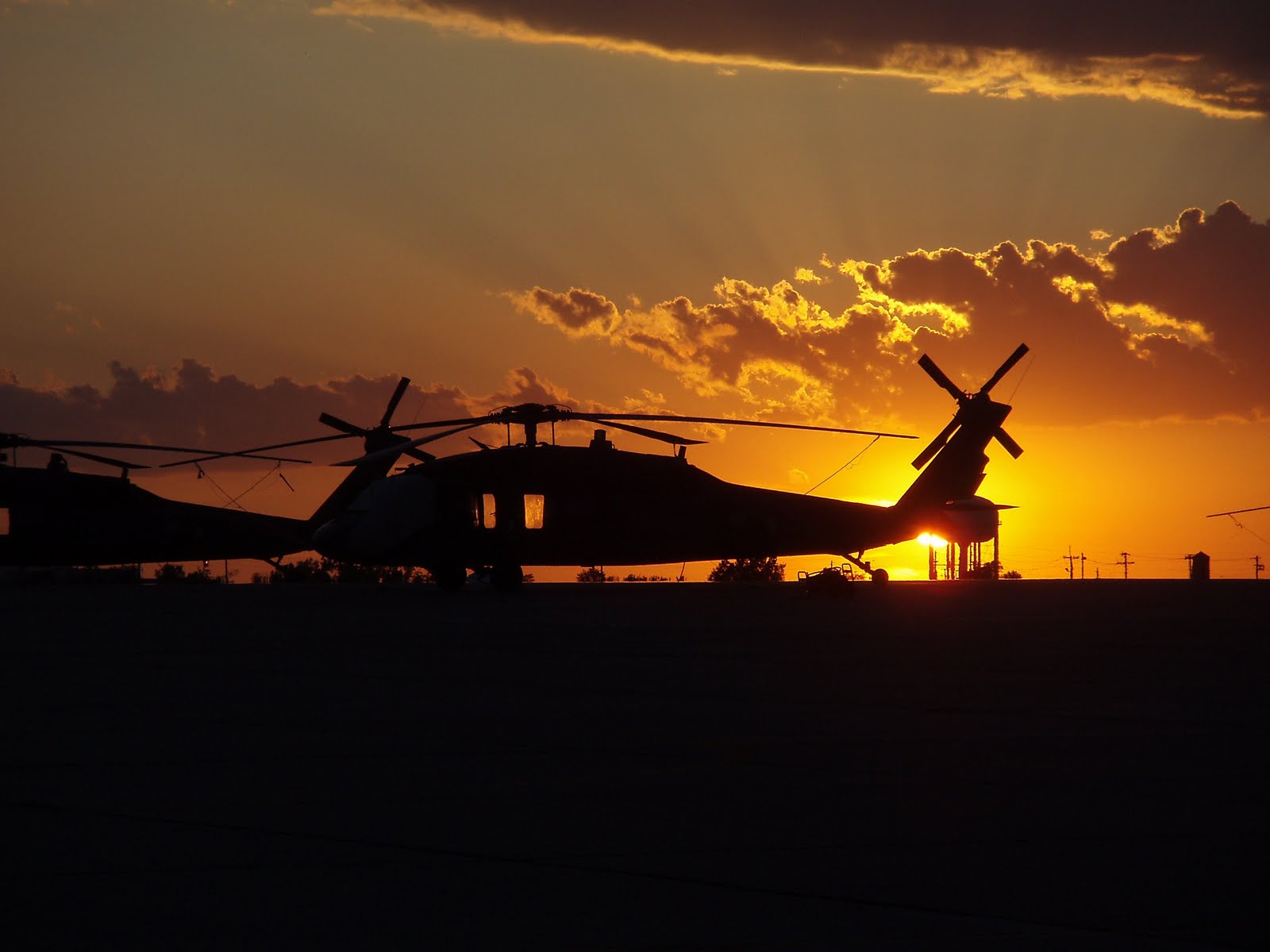
After completing nine years of active duty and finishing up with eleven years of part-time guard status, it is finally time to hang up the uniform.
It has been a wild ride, with five deployments to the Middle East and Bosnia and an overseas tour in Korea, which is nothing compared to the deployment schedules of today's active duty troops.
I worked with some great people at times, I learned most of what I know about working with others, and I learned to fly helicopters first in the Army. I have served alongside many different people who had come together to accomplish something bigger than themselves, and have known quite a few that have lost their lives in defense of our country. Regardless of the politics or the situations they find themselves in, the all-volunteer troops who serve today perform their duties honorably and faithfully, as I hope and pray they will always do for the good of our country.
Finally, I was blessed to meet my wife while I was on active duty at Fort Hood, and I owe her much for her love and patience during all my extended time away, which was never easy nor pleasant to deal with.
So to sum up my military experience, I would like to share "four things that it took me twenty years to learn in the military". See if any of these apply to your own organization, wherever you work...
1. If your boss doesn't care, you can get away with pretty much anything.
2. Formal military schooling, with all its pettiness and artificial stressors, is actually excellent preparation for the real world. If only to demonstrate that people who don't care and don't do anything in training will not care nor do anything even when lives are at stake. If you think your screwed up organization will put aside their differences and pull together when it really counts, you are as clueless as I was when I first got on the plane.
3. The full-time Army National Guard represent the absolute worst of both the DoD Civilian work force and the military, and are richly deserving of the bad reputation that they have earned among active duty types.
4. When in doubt, go Air Force.
But I'm not bitter about it... :o
Subscribe to:
Posts (Atom)